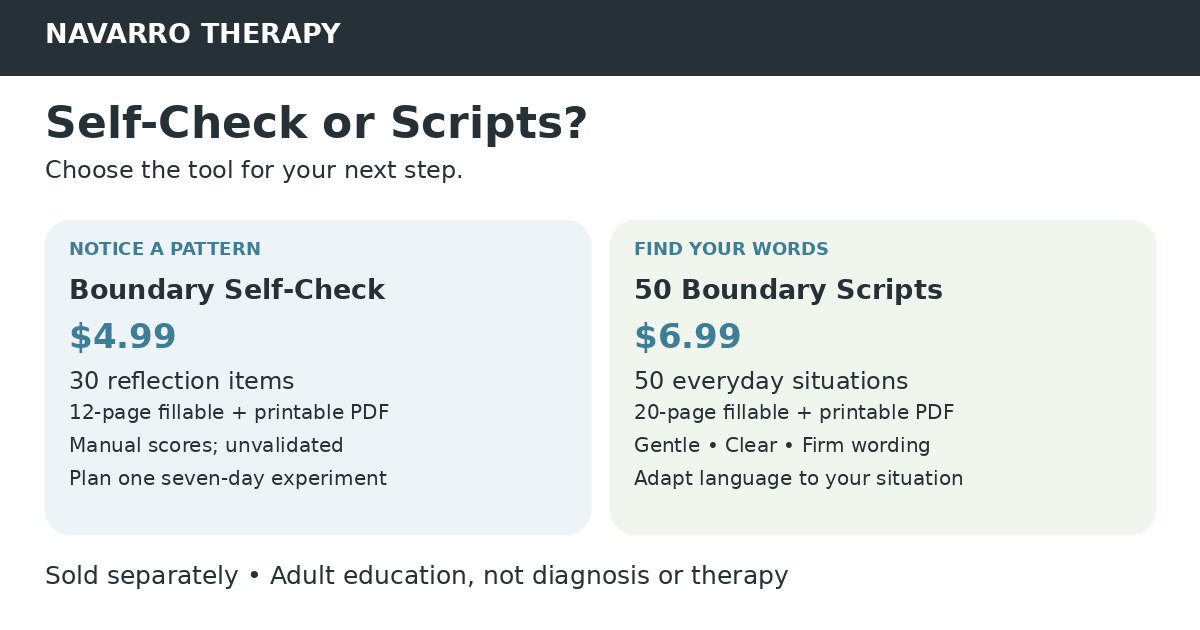
Do you say yes before checking your time or energy? Or do you know your limit but get stuck deciding what to say? Noticing a pattern and finding words are two different places to begin.
Think of it like checking a map before choosing a route: first notice where you are, then choose one next step. You do not have to work on every relationship at once.
Try a pause before the next yes
For one ordinary request, ask yourself: What is being asked? What can I realistically offer? What would an honest answer sound like?
“Let me check my time. I’ll get back to you tomorrow.”
Choose a return time you can keep. This is a practical example, not a script for every situation. Use it only where expressing a preference is safe.
The National Institute of Mental Health’s self-care guidance includes deciding which tasks are priorities and declining additional tasks when you are taking on too much. That general guidance does not validate a workbook or promise an outcome.
If you want to notice your pattern: the Boundary Self-Check
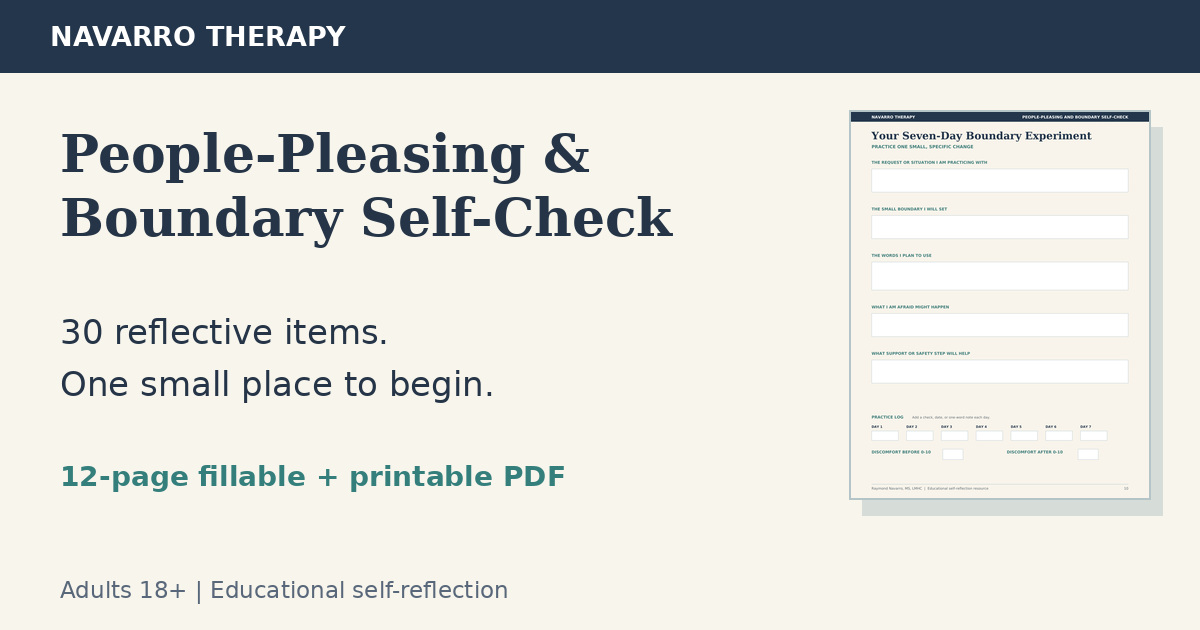
People-Pleasing & Boundary Self-Check — $4.99
This separate 12-page fillable and printable PDF offers 30 reflection items across five boundary-related areas, a Boundary Profile, a cost check and a seven-day experiment. It provides a structured place to notice a pattern and choose a manageable practice.
Scores are added manually. This is an unvalidated educational reflection resource, not a psychological test, diagnosis or measure of treatment need.
If you know your limit but need words: 50 Boundary Scripts
50 Boundary Scripts for People Pleasers — $6.99
This separate 20-page fillable and printable PDF offers 50 everyday boundary situations with Gentle, Clear and Firm wording to adapt. Topics include family, relationships, work, favors, texting, privacy and pushback, with additional reflection and practice tools.
Choose wording that fits your situation and safety. A firmer response is not automatically the right response, and a script cannot control another person’s reaction.

Choose the tool that fits your next step
Want structured reflection? Start by viewing the Self-Check. Need wording for a particular conversation? View the Scripts. Each resource can be used on its own and is sold separately; neither includes the other.
Preview the actual listing pages and file details before buying. These are digital PDFs; no physical item is shipped. Use a compatible PDF reader to type into fillable fields, or print a personal copy.
For broader guided reflection, you can also read about the existing People-Pleasing & Boundaries Reset Workbook, or compare all Navarro Therapy resources.
Reference and educational limits
National Institute of Mental Health: Caring for Your Mental Health (last reviewed April 2026; accessed October 13, 2026). Product details were checked against the existing Navarro Therapy listings. The analogy and holding response above are practical examples.
These resources were developed with AI assistance and clinical direction/review by Raymond Navarro, MS, LMHC. They are for adult personal education, not therapy, diagnosis, treatment, crisis care or medical/legal advice. Buying or using them does not create a therapist-client relationship.
If a relationship involves threats, coercion or abuse, prioritize safety and individualized support rather than confrontation. A boundary script is not a safety plan. For immediate danger, use local emergency services; in the U.S., call 911. In the U.S., call or text 988 for crisis support.

