When everything feels heavy, rest may be necessary—but it may not be enough.
Burnout and mental overload often show up as more than feeling tired. You may still be getting things done while becoming more irritable, forgetful, detached, resentful, or unable to recover between demands. Even rest can start to feel like another task on the list.
A helpful first step is to stop treating depleted capacity as a personal failure. Sometimes the problem is not that you need a better productivity system. The problem is that you are carrying more demands, decisions, emotional labor, and open loops than your current resources can sustainably support.
Burnout and mental load are related—but not identical
The World Health Organization describes burnout as an occupational phenomenon related to chronic workplace stress that has not been successfully managed. People can also experience serious overload outside of work through caregiving, household coordination, financial strain, health demands, relationship roles, or several pressures happening at once.
This distinction matters because a workbook cannot diagnose burnout, and “self-care” cannot repair every structural problem. However, making the load visible can help you decide what needs recovery, what needs support, and what may need to change.
A practical four-part reset
- Reduce: What can become smaller, simpler, less frequent, or merely good enough?
- Renegotiate: Which deadline, expectation, role, or responsibility needs a clearer conversation?
- Remove: What no longer belongs on your list—or never belonged there in the first place?
- Recover: What genuinely restores capacity rather than only helping you escape for a short time?
Recovery matters, but recovery works better when the backpack is also made lighter.
Try this five-minute mental-load check
- Write down the tasks, decisions, reminders, worries, and responsibilities currently occupying mental space.
- Circle one item that someone else could help carry.
- Underline one item that can be delayed, simplified, or completed to a “good-enough” standard.
- Choose one small action that protects capacity today.
The goal is not to solve your entire life in five minutes. It is to turn an invisible cloud of pressure into one visible next decision.
The Burnout & Mental Load Reset
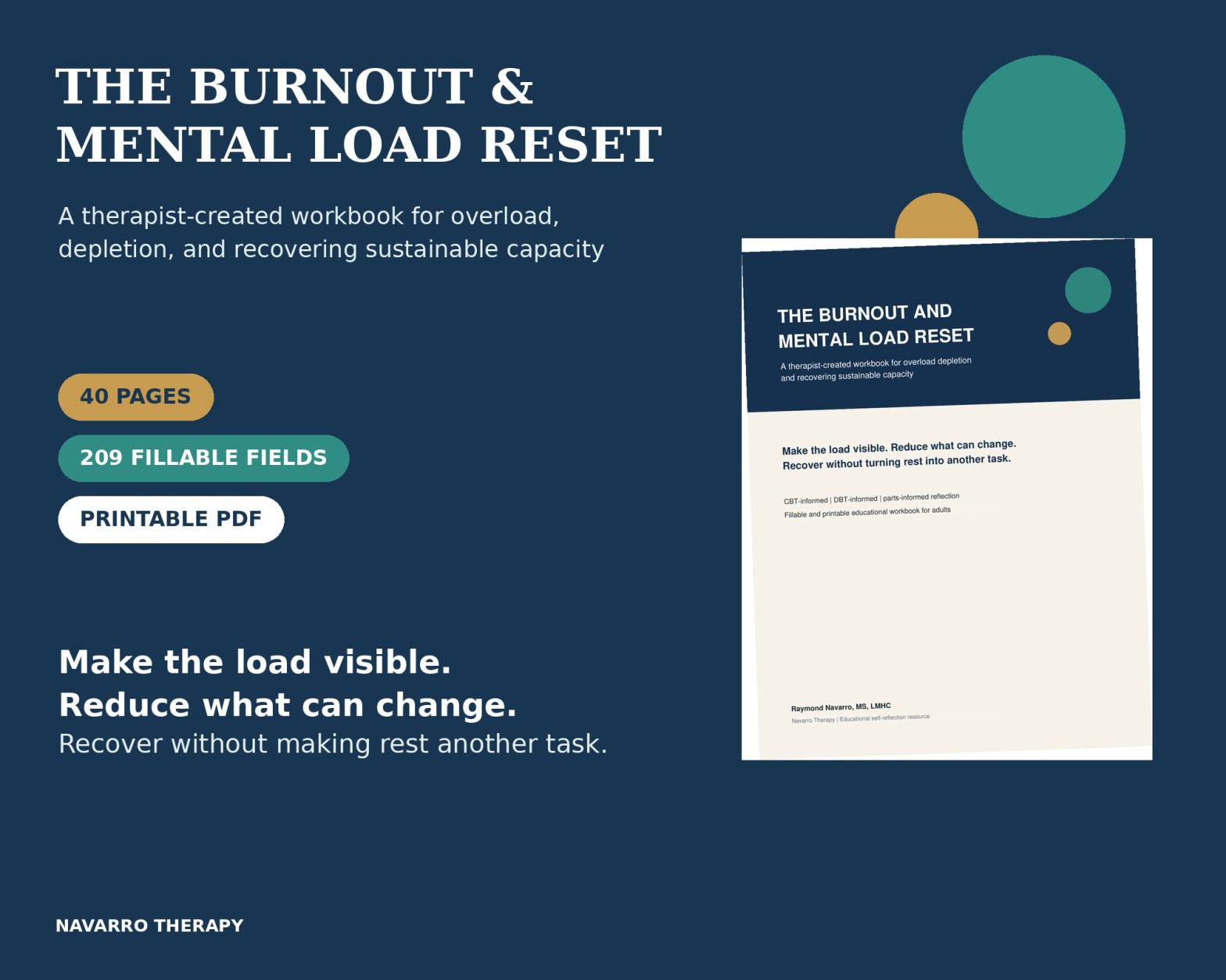
This therapist-created digital workbook is designed for adults who are still functioning but feel overloaded, depleted, or unable to recover. It provides a structured way to identify what is consuming capacity and choose realistic changes.
- 40 fillable and printable pages
- 209 fillable fields
- An original 25-item, five-domain Starting Profile
- Mental-load, invisible-work, and capacity maps
- CBT-informed, DBT-informed, and parts-informed reflection tools
- A Minimum Viable Day exercise
- Delegation, boundary, support, and work-redesign prompts
- A seven-day capacity experiment and Sustainable Capacity Plan
Digital download: No physical item will be shipped. The workbook is $12.99 on Etsy.
Educational limits and safety
This resource and article are for education and self-reflection. They are not psychotherapy, diagnosis, medical advice, employment advice, or crisis care, and they do not create a therapist-client relationship. The Starting Profile is original and nonvalidated; it organizes reflection rather than determining a diagnosis or level of severity. If symptoms persist, intensify, or interfere with work, relationships, sleep, self-care, or safety, consider seeking assessment from a qualified professional. In an immediate emergency, contact local emergency services. In the United States, call or text 988 for suicide or emotional-crisis support.
References
- World Health Organization. (2019). Burn-out an occupational phenomenon: International Classification of Diseases.
- Demerouti, E., Bakker, A. B., Nachreiner, F., & Schaufeli, W. B. (2001). The job demands-resources model of burnout. Journal of Applied Psychology, 86(3), 499–512. https://doi.org/10.1037/0021-9010.86.3.499
- Daminger, A. (2019). The cognitive dimension of household labor. American Sociological Review, 84(4), 609–633. https://doi.org/10.1177/0003122419859007
- Sonnentag, S., & Fritz, C. (2007). The Recovery Experience Questionnaire. Journal of Occupational Health Psychology, 12(3), 204–221. https://doi.org/10.1037/1076-8998.12.3.204

