You set a limit, and then the guilt arrives.
Maybe someone sounded disappointed. Maybe they became quiet, frustrated, or surprised. The uncomfortable feeling can make a quick reversal seem like the kindest option: I should take it back. I should make this easier for them. Maybe I was selfish.
Guilt can be useful information, but it is not a final verdict. Think of it as a dashboard light, not a judge’s gavel. A dashboard light tells you to inspect something. It does not tell you, by itself, what is wrong or what repair is needed.
Research on guilt-proneness has linked it with constructive intentions, corrective action, non-hostile discussion, and reappraisal after conflict. That research does not specifically test personal boundaries, and it does not mean every guilty feeling proves that harm occurred. A more useful question is: What, exactly, needs to be checked?
1. Check your behavior, not only the other person’s reaction
Another person’s disappointment is real, but disappointment and mistreatment are not the same thing.
Ask:
- Did I insult, threaten, or punish the person?
- Did I communicate the limit clearly?
- Did I change an agreement without acknowledging the effect?
- Or did I simply say what I can and cannot do?
Someone can dislike a respectful boundary. Their reaction may still matter, but it does not automatically make the boundary wrong.
2. Check whether the boundary stays on your side of the line
A boundary usually describes your participation, availability, or response.
- “I am not available to discuss this while we are yelling.”
- “I can help for one hour, but I cannot take over the entire task.”
- “If the conversation becomes insulting, I will step away and return later.”
A useful way to phrase a boundary is to describe your own participation and what you will do if a situation continues, rather than tell another person what they must choose. Real relationships are more complicated than a slogan, but this approach can help you revise the wording without abandoning the need.
3. Check for repair without erasing the limit
Sometimes the boundary is reasonable and the delivery needs repair.
You can say:
I still need the limit I described. I also realize my tone was sharp, and I am sorry for that. Let me say it more clearly.
Repair does not always mean returning to the old arrangement. You can acknowledge impact, correct inaccurate wording, or offer a realistic alternative while keeping the central limit.
4. Check what the guilt is protecting
The feeling may be connected to a value: kindness, reliability, loyalty, fairness, or care. Try naming the value without turning it into a rule that you must always be available.
- “I value being dependable, and I also need limits on what I promise.”
- “I care about this relationship, and I cannot agree to that request.”
- “I want to be generous without making commitments I cannot sustain.”
You can treat values as directions rather than demands for perfection.
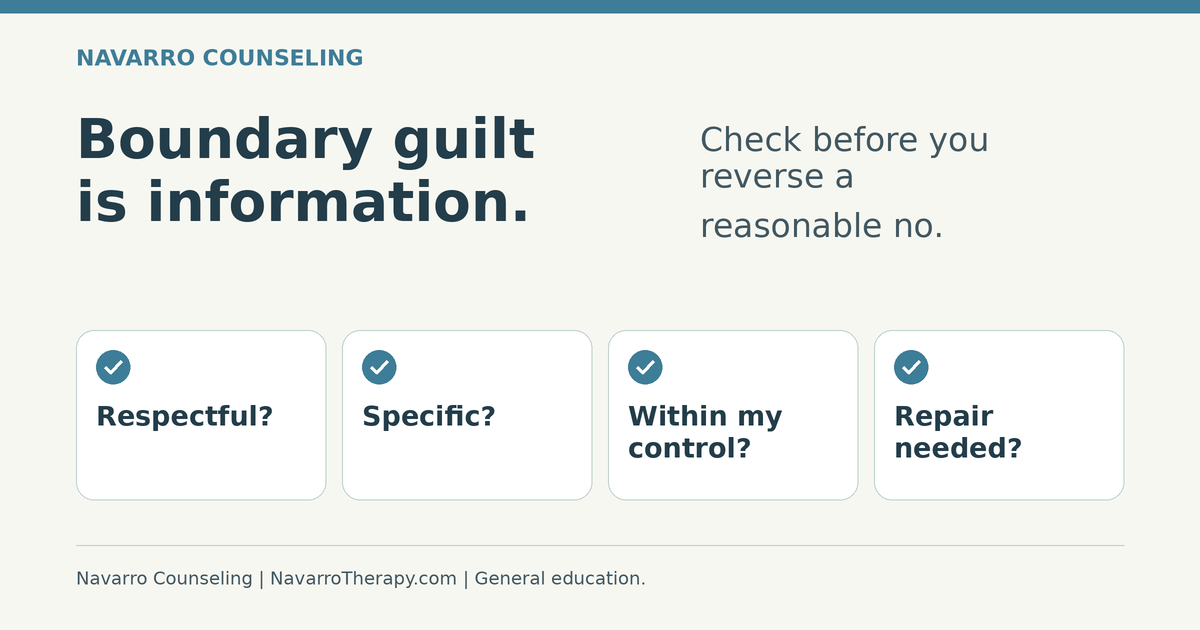
A four-question boundary audit
Before reversing a limit, pause and write:
- What did I actually say or do?
- Was it respectful, specific, and within my control?
- Is there a concrete harm to repair, or am I reacting mainly to discomfort or disappointment?
- If repair is needed, what can I change without abandoning the underlying need?
The goal is not to prove that every boundary is correct. The goal is to replace automatic retreat with a more accurate review.
Power, safety, dependence, culture, caregiving responsibilities, and workplace rules can all change what is safe or realistic. If setting a limit could increase danger, retaliation, housing risk, financial risk, or abuse, individualized planning with a qualified professional or appropriate support service may be important.
Educational limits: General psychoeducation only. This is not therapy, diagnosis, legal advice, workplace advice, or a substitute for individualized assessment. Reading this article does not create a therapist-client relationship.
Reference
- Tangney, J. P., Wagner, P. E., Hill-Barlow, D., Marschall, D. E., & Gramzow, R. (1996). Relation of shame and guilt to constructive versus destructive responses to anger across the lifespan. Journal of Personality and Social Psychology, 70(4), 797–809. https://pubmed.ncbi.nlm.nih.gov/8636899/

