Thinking about a difficult conversation can help. Replaying it for the fiftieth time usually feels different.
The difference is not simply how long you think. It is whether the thinking produces clearer information or a workable next step.
Imagine reviewing game footage. A useful review identifies one play, notices what happened, and chooses what to practice next. A replay loop watches the same mistake from every angle while the score never changes.
One small experiment helps explain why the form of thinking may matter. Watkins and Moulds compared abstract and concrete self-focus in 40 depressed patients and 40 never-depressed controls. Relative to abstract self-focus, concrete self-focus improved social problem-solving in the depressed group. The study was small and specific; it does not prove that a short exercise treats rumination or works the same way for everyone. It does support a practical distinction between broad evaluative questions and specific observable questions.
Abstract replay
Abstract replay often sounds like:
- Why am I always like this?
- What does this say about me?
- Why can’t they understand me?
- What if the whole relationship is ruined?
These questions are emotionally powerful, but they are difficult to answer. They invite more evaluation without defining a decision.
Concrete reflection
Concrete reflection asks:
- What exact moment am I reviewing?
- What words were said?
- What information was missing?
- Is there a decision I can make now?
- What is one action I can observe myself taking?
Concrete does not mean emotionless. It means the thought is connected to a specific event, choice, or next step.
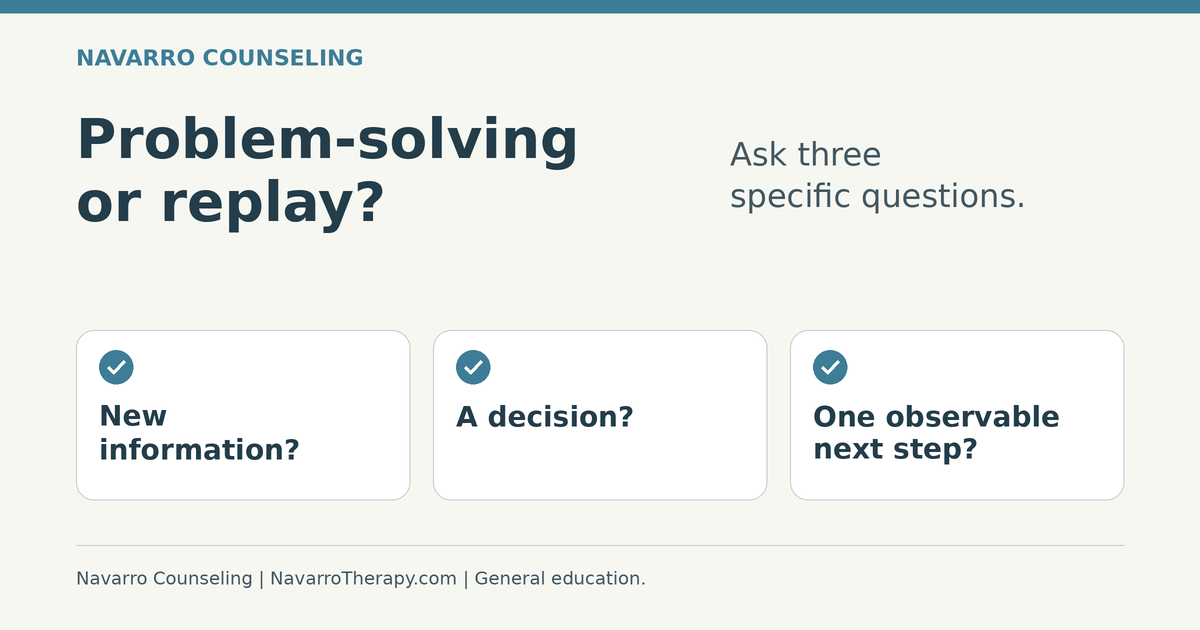
The three-question test
When you notice a loop, ask:
- Am I finding new information?
- Is there a decision I can make?
- Is there one observable next step?
If the answer to all three is no, you may be replaying rather than problem-solving.
A five-minute conversion
Write one sentence for each prompt:
- Event: “The moment I am reviewing is…”
- Known facts: “What I directly observed was…”
- Uncertainty: “What I do not know is…”
- Decision: “The choice that is actually mine is…”
- Next step: “Within 24 hours, I will…”
Examples of a next step might include drafting one sentence, asking one clarifying question, placing the issue on tomorrow’s task list, or deciding that no action is needed today.
If there is no current action, choose a stopping point: “I have recorded what matters. I will review it Tuesday at 6 p.m.” A stopping point is not a guarantee that the thought will disappear. It is a decision about where you place your attention next.
When the loop keeps returning
Repeated thought loops can have different causes, and a post cannot determine yours. If they are frequent, distressing, or interfering with sleep, work, relationships, or daily functioning, consider discussing them with a qualified health or mental-health professional.
Educational limits: General psychoeducation only. This is not therapy, diagnosis, or a substitute for individualized care. Reading this article does not create a therapist-client relationship.
Reference
- Watkins, E., & Moulds, M. (2005). Distinct modes of ruminative self-focus: Impact of abstract versus concrete rumination on problem solving in depression. Emotion, 5(3), 319–328. https://pubmed.ncbi.nlm.nih.gov/16187867/

