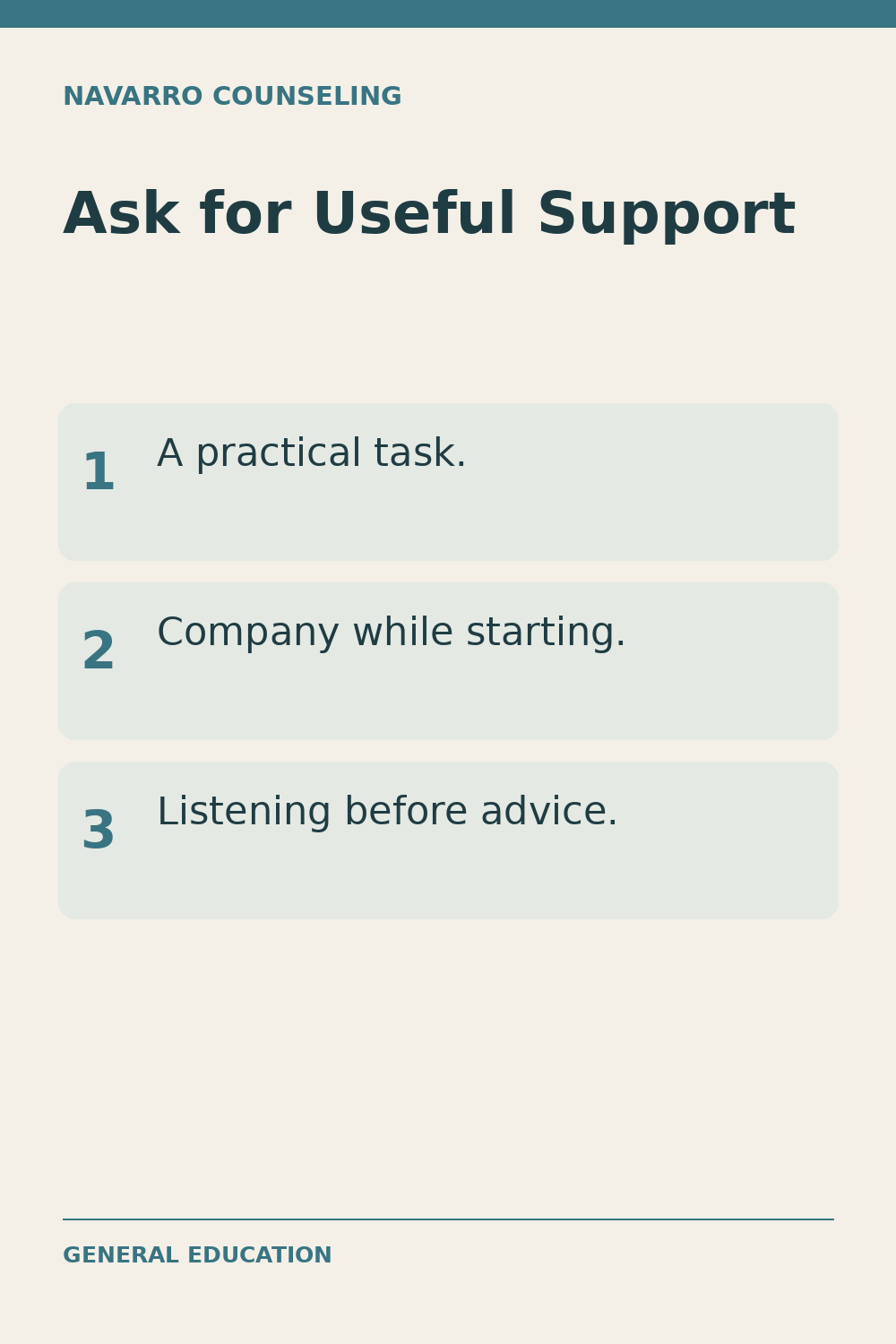
Help is not a single tool. Asking for advice when you need somebody to carry a task can feel like receiving directions while your hands are full. A useful first question is not simply whether you need support, but what job that support needs to do.
Three requests to try
These are original communication examples, not a validated assessment. For practical help: Could you handle the grocery pickup this Thursday? For company: Could you sit with me while I sort the paperwork for ten minutes? For listening: Could you hear me out before we discuss solutions? Each request gives the other person a clearer task and leaves room for an honest answer.
Make room for a no
A specific request is not a demand. The other person may be unavailable, uncertain or unable to help. You can ask whether a smaller version is realistic, approach somebody else, or use a service that fits the situation. Depending on one person for every kind of support can leave both of you without a workable plan.
Write down what is getting harder
If you are considering professional help, prepare a short private note about the changes you have noticed and the tasks they affect. Include when they began and what you have already tried. This is preparation for a conversation, not evidence that you have a particular diagnosis. You do not have to wait until every area of your life stops working before asking a question.
Self-help has a role and a limit
NIMH describes self-care as support for well-being and, when relevant, treatment and recovery. It also recommends professional help for severe or distressing symptoms and difficulty carrying out usual activities. Those ideas can coexist. A worksheet can organize a thought; it cannot provide an individualized evaluation or promise an outcome.
A low-pressure first conversation
You could tell a primary care provider: I have noticed a change in my concentration and daily routines, and I would like to discuss what might explain it. Or you could ask a mental-health professional about assessment, availability, costs and whether their approach fits your concern. You can bring a written note if speaking spontaneously is difficult.
Seasonal application
Before a busy weekend, make one practical request and one plan for rest or connection. For Halloween on Saturday, October 31, that might mean arranging a quieter activity, sharing a hosting task, or agreeing on an exit time. This is ordinary planning, not a claim that Halloween causes a mental-health condition.
General adult education, not diagnosis, psychotherapy, individualized medical advice or a therapist-client relationship. In an immediate emergency, contact local emergency services. No public disclosure of personal symptoms is requested.
References
NIMH, Caring for Your Mental Health; last reviewed April 2026

